
Background
Ampfield sells portable power stations in three sizes that run a fridge, a laptop or a work light off-grid, then refill from the wall, the car or solar. Buyers are campers, vanlifers and households wanting backup.
Challenge
Wh, W and PD mean little to most people—“how long will my fridge run?” is the real question. The site had to translate electrical specs into everyday situations.
Our Role
- Interaction Design
- Web Design
- Frontend Development
Solution
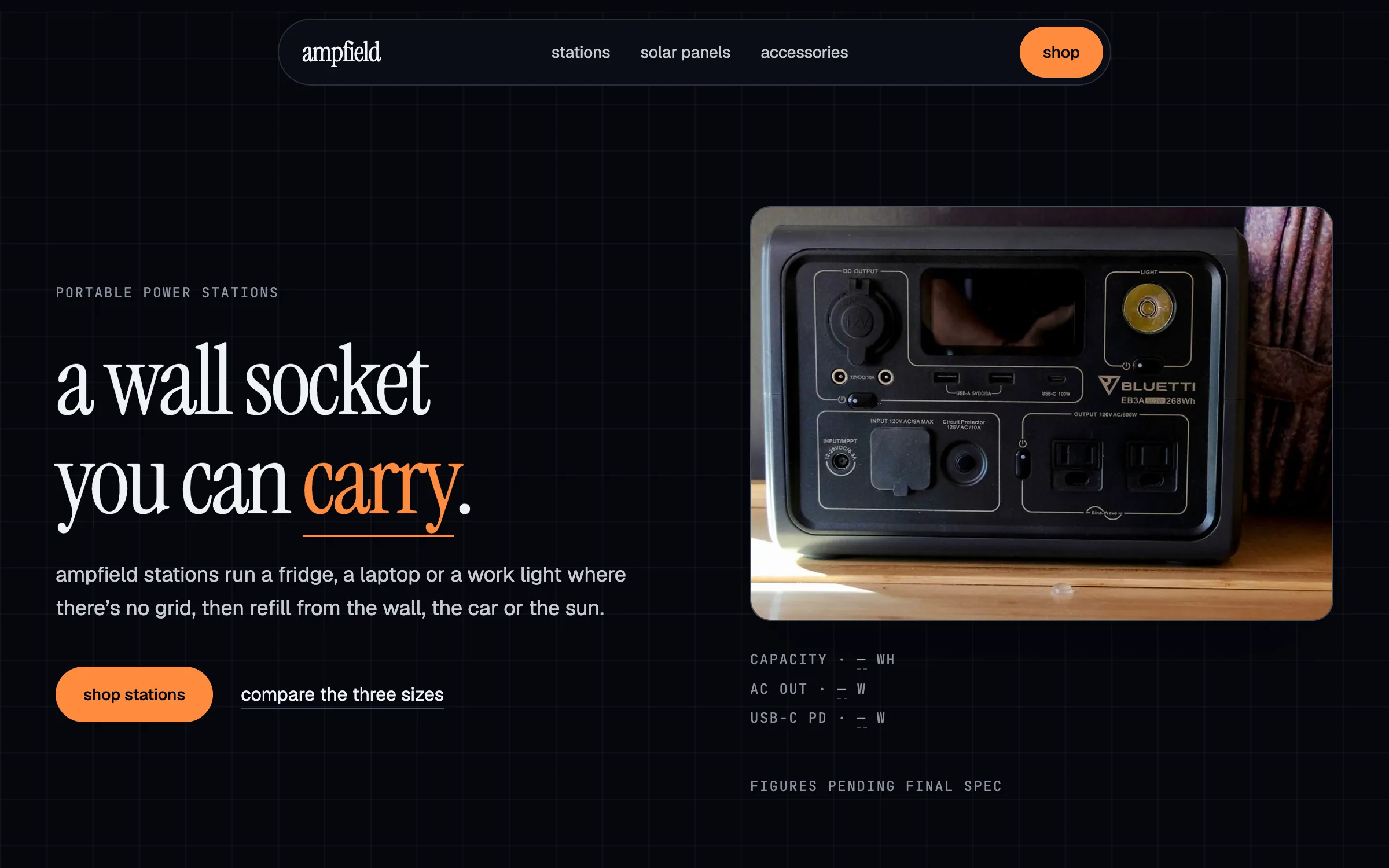
A dark, engineered interface uses a single orange as the visual sign for power. A product photo in the hero builds trust; four diagrams cover the four ways to refill; a load calculator turns device watts into runtime; and a three-size table finishes the choice.
A runtime calculator
Enter the watts for a camping fridge, laptop and LED light to get runtime from capacity × 0.85 ÷ load, with a warning for kettles and hair dryers.
Four refill diagrams
Wall, car, solar and pass-through each get a line diagram of energy flow; unconfirmed charge times stay as placeholders.
A three-size comparison
Capacity, AC output, solar input, weight and price line up across three sizes, each matched to a use: weekend, fridge-plus-laptop, or tools.
Frequently asked questions
The questions we’re asked most about this project’s design choices and delivery.
How do you make power station specs readable for ordinary buyers?
Wh, W and PD mean little to most people—the real question is “how long will my fridge run?” So we built a runtime calculator: enter device watts and it returns runtime from capacity × 0.85 ÷ load, translating electrical specs into everyday situations.
Why draw all four ways to recharge?
Wall, car, solar and pass-through are the questions buyers ask most. A line diagram of energy flow for each is faster to grasp than a paragraph, and unconfirmed charge times stay as placeholders to swap in later.
How do the three sizes help people choose?
The comparison lines up capacity, AC output, solar input, weight and price, then pairs each size with a use: weekends, fridge-plus-laptop, or tools on long trips. People choose by situation rather than by spec.
How long does a product site with an interactive calculator take?
Interactions like the calculator are lightweight front-end components with no backend, so the site still deploys statically. Including interaction design, product sites like this usually launch in 4 to 6 weeks.
Have a similar project in mind?
Tell us your goals and we'll reply within one business day.
Book a consultation